
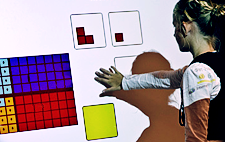




Du har hittat till Rutiga Familjen, matematikspelet som föddes 1996. Sedan dess står spelet i fokus för forskning kring grundskolematematik. Under åren har forskningsprojektet finansierats från olika håll. Varje finansieringstillfälle innebär oftast en specificering av de målen vi vill uppnå. Det övergripande syftet med denna forskning är dock detsamma: att matematik ska vara roligt. Parallellt med forskningsresultaten utvecklas detta syfte ytterligare, vi fokuserar för närvarande på: förståelse, attityd samt självbedömning.
- Vända trenden "matte är svårt". Att förstå matematik från grunden, grafiskt och till en början utan symboler och tal, för att sedan stegvis införa det traditionella matematikspråket.
- Vända trenden "matte är tråkigt". Att tycka om matematik i den meningen att tycka att ämnet är helt ok, såklart är det bonus när eleven tycker att matte är jättekul.
- Vända trenden att "man inte duger i matte". Att inse sin egen förmåga och bedöma att man kan eller tror sig kunna lösa uppgiften.
Forskning innebär konkret att spelet används som pedagogiskt material av aktiva lärare, att spelet spelas av verkliga elever i reella klasser, att spelet utvecklas i takt med forskningsresultaten samt att forskningsartiklar skrivs och presenteras/diskuteras internationellt. Det medför även att matematikspelet Rutiga Familjen uppmärksammas i pressen, av kommuner, privatpersoner, mm.
En ny version av Rutiga Familjens matematikspel har lanserats! Denna uppgradering medför bl.a. en optimerad spelhastighet för en ökad spelupplevelse, tillkomsten av åtta nya spel och hjälp till varje spel som kort beskriver spelmålet och poängtilldelningen. Läs mer om spelets nya version.
Fördjupa dig i materialet och tveka framförallt inte att testa spelet!

 Till APLEC konferensen International Workshop on Adaptation and Personalization in E-B/Learning using Pedagogic Conversational Agents, in Hawaii, USA, presenterade Lena Pareto följande artikel 2010: A Teachable Agent Game for Elementary School Mathematics promoting Causal Reasoning and Choice (eftersom artikeln publiceras internationellt, är den på engelska.)
Abstrakt: We describe a mathematics computer game for children designed to promote causal reasoning, choice-making, and other higher-order cognitive activities. The game consists of a choice-based board game, enhanced with a conversational, teachable agent, taught to play the game, by the child, through demonstrations and questions. Game design is motivated by causal reasoning theory and educational psychology. The game is currently evaluated in an ongoing large-scale study that seeks to investigate the game’s effects on the players’ abilities to reason and make productive choices. The study involves 20 elementary-school classes at different levels. » Läs mer på s.18- Publicerat 2010, Jun 20 (0 kommentar)
Studien ingår i WGLN-finansierat projektet ”Talking and Seeing Maths” och ämnar att utvärdera de olika lärmodes i matematikspelet Rutiga Familjen för att förstå vad det är i spelet som gör att eleverna lär sig bättre. Studien har olika utgångslägen. Detaljerna kring dessa avslöjas först efter att studie är genomförd.
Under fyra veckor i november-december 2012 genomförs studien i fyra grundskolor med 120 fjärdeklassare från Trollhättans kommun. I varje klass delas eleverna upp i socialt fungerande par som har ungefär samma nivå i matematik. Alla par tilldelas sedan en specifik lärmode att arbeta utifrån. Paren får specifika uppgifter att utföra och utmaningar att möta. Studien påbörjas och avslutas med pre- resp. posttester i attityd, självvärdering och matematik.
Studien bedrivs i samarbete med Annika Silvervarg från Linköpings Universitet och Daniel L. Schwartz från Stanford University, Usa.
- Publicerat 2012, Nov 19 (0 kommentar)
- Till ICDVRAT konferensen, 9th International Conference on Disability, Virtual Reality and Associated Technologies, in Laval, France, presenterade Lena Pareto följande artikel september 2012: Mathematical Literacy for everyone using Arithmetic Games (eftersom artikeln publiceras internationellt, är den på engelska).
Abstrakt: An innovative mathematics game shown to be effective for low-achieving mainstream students is tested in special education for learners with intellectual disabilities. The game relies on a graphical, intuitive representation for numbers and arithmetic operations to foster conceptual understanding and numbers sense, and provides a set of 2-player games to develop strategic thinking and reasoning skills. The game runs on computers and interactive white boards, and as an augmented reality application at a science centre. We compare its use in special education and mainstream education with respect to usage, performance levels and learning gain. The game has been used by teachers in special educations, with gains in mathematical understanding, strategic thinking and communication skills as effects. » För närvarande är endast abstraktet publicerat. Artikeln publiceras online den 15:e mars 2013 i ICDVRAT:s arkiv.
Ta del av Lena Paretos presentation: Mathematical Literacy for everyone using Arithmetic Games - Publicerat 2012, Sep 11 (0 kommentar)
- Till EC-TEL konferensen 5th European Conference on Technology Enhanced Learning, i Barcelona, Spanien, publicerades följande artikel 2010: The Complexity of Integrating Technology Enhanced Learning in Special Math Education: a Case Study (eftersom artikeln publiceras internationellt, är den på engelska.)
Abstrakt: We present a study of integrating an educational game in special math education, to explore challenges faced during the process. The game promotes an unconventional approach supporting students having math difficulties, through visual representations, learn-by-exploration and learn-by-teaching models. Our conclusion is that integration in special education is more challenging than in the main stream counterpart, due to social vulnerability of the students, learning/teaching challenges in content, motivation and attitude, a non-typical learning situation, and the challenge of matching learning peers. » Läs mer - Publicerat 2010, Sep 28 (0 kommentar)
- En ny artikel ”A Teachable Agent Game Engaging Primary School Children to Learn Arithmetic Concepts and Reasoning” har publicerats i en internationell tidskrift om intelligenta spel och andra digitala verktyg i skolmiljö: International Journal of Artificial Intelligence in Education av Springer
(eftersom artikeln publiceras internationellt, är den på engelska).
Abstrakt: In this paper we will describe a learning environment designed to foster conceptual understanding and reasoning in mathematics among younger school children. The learning environment consists of 48 2-player game variants based on a graphical model of arithmetic where the mathematical content is intrinsically interwoven with the game idea. The environment also features teachable agents, which are computer programs that can be taught and behave according to their knowledge. Thus, the environment provides both learning-by-doing (playing the game) and learning-by-teaching (teaching the agent to play). It differs from other learning-by-teaching systems 1) by targeting basic mathematics and primary grade students; 2) by using teachable agents as an extension to educational games in order to leverage engagement, reflection and learning; and 3) by using an agent-driven question dialogue to challenge students’ mathematical thinking, to role-model learner behaviour and to transfer game knowledge to out-of-game mathematics. The teachable agent game is described and evaluated in an authentic classroom study enrolling 443 students from 22 classes in 9 schools. Students range from 2nd to 6th grade of mainstream classes and 7th to 8th grade for students with difficulties in mathematics. Part of the study was designed as a quasi-experimental study with controls; part was designed to examine students’ change in mental models of arithmetic before and after game play. All students took pre- and post mathematics tests. The 314 playing students used the game and taught their agents during regular math-classes for three months, whereas the control classes attended standard instruction and took the tests. A questionnaire was distributed in the end of the study to investigate students’ perceptions and performances of the agent-tutoring task. Results show that 1) there is a significant learning gain for playing student compared to controls, 2) the learning environment can engage children in advanced mathematical thinking in early education, 3) that young primary students can act as successful tutors. Thus, we conclude that teachable agents is a candidate for leveraging learning in educational games to deeper levels that transfer outside the game. This idea combines the motivational power of games with the reflective power of a teachable agent asking though-provoking, deep questions on the learning material during game play.Pareto, L. (2014). A Teachable Agent Game Engaging Primary School Children to Learn Arithmetic Concepts and Reasoning. In International Journal of Artificial Intelligence in Education, Volume 24, Issue 3, pp 251-283. Springer New York.
- Publicerat 2014, Sep 18 (0 kommentar)
- Till AIED konferensen 15th International Conference on Artificial Intelligence in Education, in Auckland, Nya Zeeland, presenterade kollegan Björn Sjödén tillsammans med Lena Pareto, Betty Tärning samt Agneta Gulz (Lund Universitet) följande artikel 2011: Transferring Teaching to Testing – An Unexplored Aspect of Teachable Agents (eftersom artikeln publiceras internationellt, är den på engelska.)
Abstrakt: The present study examined whether socio-motivational effects from working with a Teachable Agent (TA) might transfer from the formative learning phase to a summative test situation. Forty-nine students (9-10 years old) performed a digital pretest of math skills, then played a TA-based educational math game in school over a period of eight weeks. Thereafter, the students were divided into two groups, matched according to their pretest scores, and randomly assigned one of two posttest conditions: either with the TA present, or without the TA. Results showed that low-performers on the pretest improved significantly more on the posttest than did high-performers, but only when tested with the TA. We reason that low-performers might be more susceptible to a supportive social context – as provided by their TA – for performing well in a test situation. » Läs mer - Publicerat 2011, Jun 27 (0 kommentar)
Как маркетинговое агентство работает с ограниченным бюджетом клиента?